Year

2025

Duration

1 Year

Role

UX Researcher & Product Designer

Software

Project

Gym Motivation Application

Design a mobile application that addresses barriers to consistent gym attendance by fostering social motivation, environmental accountability, and rewarding fitness behaviors.


PRODUCT DESIGN

Summary

This project explores how a mobile application can enhance gym attendance and engagement by tackling two primary challenges: lack of social support and environmental factors. Through a user-centered design approach, I conducted research, co-design sessions, and expert interviews to identify real user needs and motivations. The resulting app integrates features such as QR check-ins, friend activity feeds, challenges, and locker cleanliness verification to promote social accountability, gamified motivation, and a well-maintained gym environment. The design was validated through an interactive university exhibition, where audience feedback confirmed the effectiveness of these solutions in fostering community, encouraging consistent workouts, and rewarding responsible behaviors.

Challenge

  • Despite strong intentions to stay active, many gym members struggle to maintain consistent attendance and engagement. Research revealed three core challenges affecting the overall gym experience.

Problem

  • Inconsistent gym attendance and declining long-term engagement
  • Low motivation to maintain regular workout routines

Who is affected?

  • New gym members lacking confidence or social connection
  • Individuals who prefer social workouts but train alone
  • Regular users discouraged by poorly maintained facilities
  •  

Underlying Reason

  • Lack of social support: Absence of encouragement, accountability, and peer motivation
  • Environmental factors: Unhygienic lockers and unclear responsibility for shared spaces
  • Low accountability: No visible progress, rewards, or recognition to sustain motivation

Design Process

01

Empathize

02

Define

03

Ideate

04

Prototype

05

Test

01 EMPATHIZE

The Shift in Perspective

The first step of my design process focused on understanding rather than assuming. Many gym users struggle with consistency. This challenge is often framed as a problem of discipline or time management. However, rather than accepting these surface-level explanations, I set out to uncover what truly disrupts commitment to a workout routine.

01 EMPATHIZE

Research Approach

Informal Interviews

Capture real, unfiltered user stories.

Semi-structured Conversations

Explore emotional and social patterns.

Literature Review

Understand psychological factors behind motivation.

Co-Design Workshop

Engage users as collaborators, not subjects.

01 EMPATHIZE

A Closer Look at the Co-Design Workshop

While surveys and interviews revealed surface-level patterns, I facilitated a co-design session to uncover deeper emotional and behavioural drivers behind gym attendance.

  • Designed the workshop structure and activities

  • Facilitated group discussions and exercises

  • Guided prioritization and decision-making

  • Synthesized emerging themes and behavioral patterns

The workshop brought together six regular gym-goers aged 18–35. All participants attended the gym at least twice a week and represented diverse academic backgrounds.

This age group was intentionally selected due to fluctuating intrinsic motivation and schedule pressure, making consistency a common challenge.

In addition, I conducted a separate semi-structured interview with an experienced gym coach to validate and deepen the behavioral findings from the workshop.

01 EMPATHIZE

Workshop Flow: Step by Step

1.Creating Psychological Safety

We began with an icebreaker and informal introductions. Participants shared how often they go to the gym and how they generally feel about their routines.

This step helped establish trust and encouraged open participation.

2.Externalizing Experiences

Participants individually documented their positive and negative gym experiences.

To visually structure the discussion, positive experiences were placed on a green board and negative experiences on a red board.

This visual separation helped balance emotional responses and prevented the conversation from becoming overly problem-focused.

3.From Experiences to Problems

After reviewing shared experiences, participants identified at least three concrete challenges they personally encountered at the gym.

This activity helped move the discussion from broad storytelling to clearly articulated problem statements.

4. Democratic Prioritization

Each participant presented the problem they believed was most important.

Through structured voting, the group collectively selected the issue that felt most impactful and worth exploring further.

This ensured ownership of the problem definition and avoided facilitator bias.

5. Collaborative Ideation

The session concluded with a focused brainstorming exercise addressing the selected issue.

Participants generated potential solutions and discussed what kind of intervention would feel realistic and supportive in their daily routines.

Notably, the preference for a mobile-based solution emerged organically from participants rather than being introduced as a predefined outcome.

02 DEFINE

From Patterns to Clarity

Building on the insights gathered during the Empathize phase, I shifted from understanding individual experiences to identifying patterns across the research. By clustering observations from interviews, co-design sessions, and secondary research, clearer themes began to emerge. The Define phase focused on distilling these themes into a focused design challenge that could guide meaningful solutions.

02 DEFINE

Key Insights

Gym-goers struggle with consistency due 

to emotional and environmental barriers.

The gym environment affects motivation,

comfort, and overall experience.

Lack of social support and accountability

lowers long-term commitment.

Existing fitness apps largely ignore

social and behavioural needs.

03 IDEATE

Turning Insights into Solution Directions

Building on insights from the Empathize and Define phases, I focused on the key barriers preventing consistent gym attendance. Two themes stood out: lack of social support, which leaves users feeling isolated and unmotivated, and environmental factors, as aspects like cleanliness and space directly affect comfort and engagement. These findings became the foundation for ideation and guided the exploration of practical solutions to improve the overall gym experience.

03 IDEATE

Sketches

Initial sketches were used to explore the structure of the experience and map potential user flows. The focus was on testing how social support, rewards, and environmental responsibility could fit into a seamless gym journey.

03 IDEATE

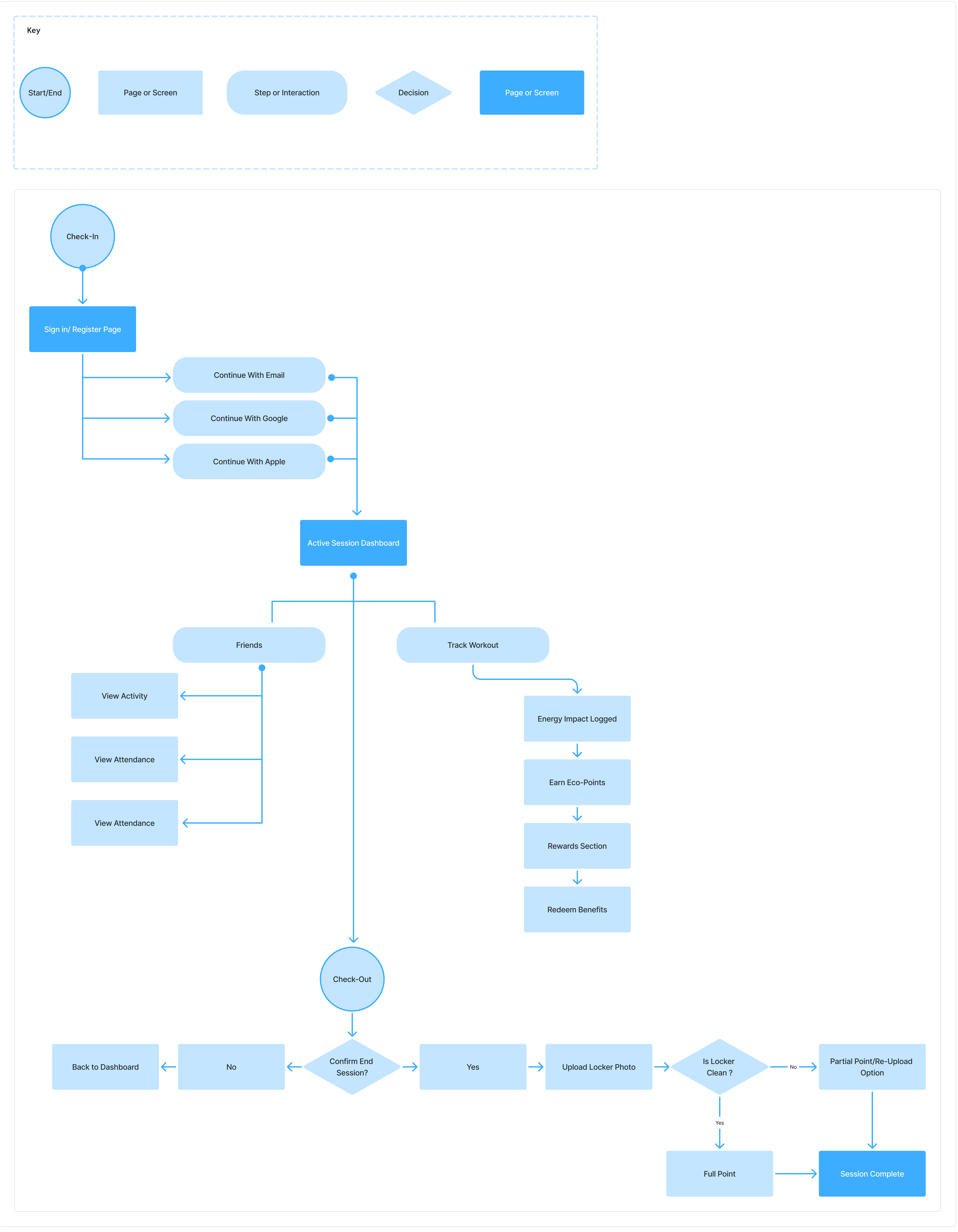
User Flow 

The user flow was designed as a motivational loop rather than a linear interaction. From check-in to check-out, the experience integrates social visibility, rewards, and environmental accountability. By reinforcing positive actions — such as workout completion and responsible locker use — through points and peer activity updates, the system encourages consistent gym attendance through behavioral reinforcement rather than discipline alone.

04 Prototype

Translating the User Flow into Interface Screens

Based on the user flow developed in the previous stage, I created a set of low-fidelity prototype screens to explore how the experience would translate into a mobile interface.

These early screens focus on the core interactions of the system — check-in, social visibility, rewards, and responsible check-out — while keeping the interface intentionally simple to prioritize structure and functionality over visual styling.

05 TEST

Concept Validation through Exhibition Feedback

Following the development of the low-fidelity prototype, the project was presented at a university design exhibition in early September. Rather than conducting a formal usability test with a fully functional application, the exhibition served as an opportunity to gather early feedback on the proposed concepts and features. Visitors explored the design boards presenting the full process from initial user insights to the proposed app features, and shared their reactions to ideas such as social motivation, activity tracking, friendly competition, and environmental responsibility within the gym experience.

05 TEST

Key Observation

• Social visibility features were perceived as motivating for maintaining gym routines
• The reward system linked to energy generation was considered engaging and innovative
• The locker cleanliness reminder raised awareness about shared responsibility in gym spaces

Final Takeaway

This project demonstrates how design thinking and participatory methods can transform user insights into meaningful digital solutions. By focusing on social motivation, environmental responsibility, and behavioral reinforcement, the proposed concept moves beyond traditional fitness tracking. Ultimately, it highlights how thoughtful UX design can support long-term engagement and healthier habits in everyday life.